
Earthquake Early Warning - Frequently Asked Questions
What is Earthquake Early Warning?
Earthquake Early Warning (EEW) is an automated process comprising the rapid detection of earthquakes, real-time estimation of the shaking hazard, and notification of expected shaking. Warning times range from a few seconds to tens of seconds depending on distance from the earthquake. The further one is away from the epicentre, the more warning time. The bigger the earthquake, the stronger the shaking, and potentially the larger the area of impact (i.e., the greater the distance from the epicentre where damage may occur).
How does Earthquake Early Warning work?
Earthquakes release energy that travels through the Earth as seismic waves. Seismic sensors detect the first energy to radiate from an earthquake, the P-wave, which rarely causes damage. The sensors transmit this information to data centres where a computer calculates the earthquake's location and magnitude, and the expected ground shaking across the region, then an alert is disseminated to people and systems in the affected regions within Canada. This method can provide up to tens-of-seconds of warning before the arrival of secondary S-waves, which bring the strong shaking that cause most of the damage.
Video: Earthquake Early Warning animation
Earthquake graphical respresentation (Transcript)
When an earthquake occurs, its (generally weak but fast) P-wave travels rapidly from the epicentre, triggering the EEW system which then alerts people and systems before the (slow but strong) S-wave arrives. These seconds to tens-of-seconds of warning allow people to protect themselves (usually to "Drop, Cover, and Hold on") and systems to take protective actions, such as stopping trains.
How does Earthquake Early Warning help?
The earthquake early warning system adds protection by providing seconds to tens-of-seconds' notice before strong shaking starts. This warning helps reduce injuries, deaths, and property losses by allowing time to enact certain precautions.
What does Earthquake Early Warning not do?
EEW systems cannot predict earthquakes. They do not provide hours of advanced warning, or even enough time to evacuate a building. Also, sites close to an earthquake's epicentre may be within the event's Late Alert Zone within which alerting is not possible before the arrival of strong shaking. Earthquakes generating only low levels of shaking do not produce EEW alerts.
EEW does not alleviate the need for other earthquake risk reduction, preparedness, and response measures, such as constructing to building code requirements.
Do Earthquake Early Warning Systems predict earthquakes?
There is currently no reliable means to predict earthquakes before they occur. EEW detects an earthquake as it occurs; fast, automated communications and processing technologies allow for the alerting of imminent shaking to most areas at risk.
How much warning time does the Canadian EEW system provide? Is it sufficient to evacuate our facility before strong shaking?
It is best to assume shaking is imminent and take immediate protective actions. For people, this is generally to Drop, Cover and Hold On (as promoted in the "ShakeOut" earthquake drills). For systems, the EEW message can trigger automated actions, such as to: open fire hall and ambulance bay doors; slow or stop trains; halt bridge and tunnel traffic; close valves and turn off heat sources; park discs on computers in data centres; pause industrial processes; and sound alarms to stop surgery (re. NRCan GeoFact sheet on EEW).
The national EEW system provides seconds to tens-of-seconds warning. When an alert is received is dependent on several factors including distance from the earthquake and how the alert is received. The farther you are from the epicentre, the more warning time you will have.
Will we always be notified of an earthquake that could affect us?
The EEW system is designed to enhance early detection and warning in areas of moderate to high earthquake hazard and concentrations of population and infrastructure. In Canada, this earthquake risk is concentrated in western British Columbia, eastern Ontario, and southern Quebec.
While NRCan has endeavoured to make Canada's EEW system as robust and reliable as possible, this cannot be completely guaranteed. False and missed alerts are inevitable, due to the necessarily automated, rapid analysis of data. Additionally, sites very close to an earthquake's epicentre may be in the event's late alert zone, within which alerting prior to the onset of strong shaking is not possible; this is not a failure of the system.
People may feel shaking, but not receive an alert; the EEW system only alerts for potentially harmful shaking levels. Earthquakes generating only low levels of shaking do not produce EEW alerts.
Does this EEW system alert for tsunami?
The EEW system is strictly for earthquake alerting.
Tsunami monitoring and alerting, while related, is an entirely different process. Seismic data recorded by NRCan are shared, however, with the National and Pacific Tsunami Warning Center (NTWC) in Alaska and the Pacific Tsunami Warning Center on Hawaii, both at www.tsunami.gov. The NTWC monitors for tsunami with the potential to impact North American coastlines and issues tsunami messages that are disseminated through appropriate agencies in Canada. This is mostly applicable for tsunami generated by earthquakes elsewhere around the Pacific and Atlantic Oceans, providing sufficient time for assessment of the event and notification to North American Regions with oceanic coastlines.
For tsunami waves generated locally and regionally, it is important to understand that the strong, long (>1min) shaking from an earthquake is the most reliable alert that a tsunami could inundate nearby coastlines.
Might alerts be received for earthquakes on the other side of our international borders?
The design of the Canadian EEW system provides the ability to alert for any earthquake potentially impactful to Canadian areas of high risk. NRCan is working with US partners and is employing the USGS's EEW software to facilitate data sharing between the two countries; this ensures accurate alerting for earthquakes close to the Canada-United States border.
The USGS EEW system is currently operational in California, Oregon, and Washington.
Where is Earthquake Early Warning located?
EEW stations have been installed in areas of both moderate-to-high seismic hazard and concentrations of population and/or critical infrastructure (e.g. transportation, utilities, medical facilities). Earthquakes expected to cause strong shaking within EEW coverage areas, shown below, result in public alerts if their magnitude is estimated to be at or above 5, and shaking is estimated to reach intensities of IV or greater. These alerts are disseminated by the National Public Alerting System. Additionally, earthquakes producing strong shaking beyond this region may result in an alert to those areas.
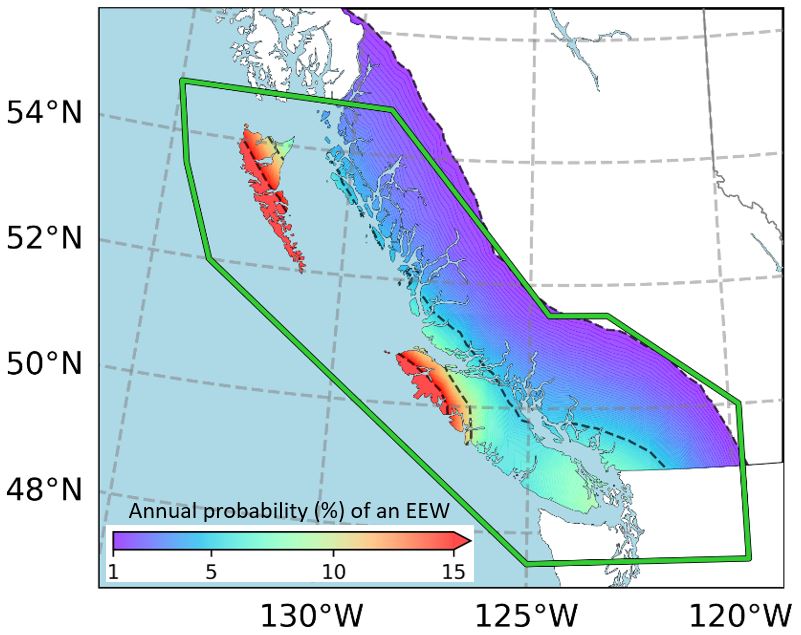
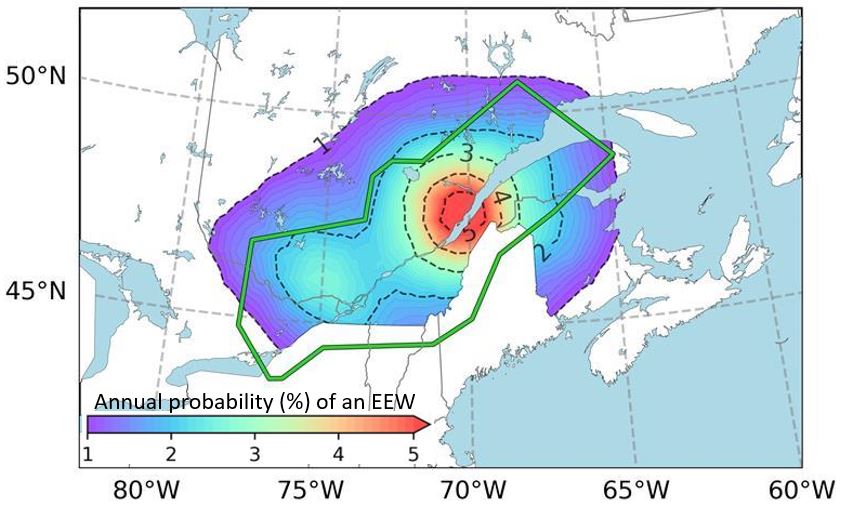
Green polygon indicates EEW coverage region; for especially large earthquakes, EEW may extend beyond these regions. Rainbow colours indicate annual probability of a public EEW.
Who receives Earthquake Early Warnings?
EEW notifications to the public are sent through the National Public Alerting System, to advise that strong shaking is likely and imminent. Infrastructure operators can receive EEW messages in a format which can trigger automated response technologies, as described above.
For more information, please contact: Earthquake Early Warning Program, Canadian Hazards Information Service, Natural Resources Canada, at: EEWinfo-infoASP@nrcan-rncan.gc.ca or 613-995-5548.